
The small village of San Roque is located in the mountains about two and a half hours out of Davao City. Pastor Roeske has arranged drivers who will meet us and take us there. He directs me to meet him at a local Lutheran church – Christ Our Savior Lutheran Church. It’s located on the western fringe of the city and by meeting there we’ll be able to eliminate some of the traffic Davao is notorious for.
We’ll also get to have breakfast with one of Pastor Roeske’s old friends and former parishioners. He’s known her since she was 14 and she first went to be a house helper for his family, under his wife’s direction. She and her family live on property at the rear of the church, and I am welcomed as an honored guest through my association with Pastor Roeske.
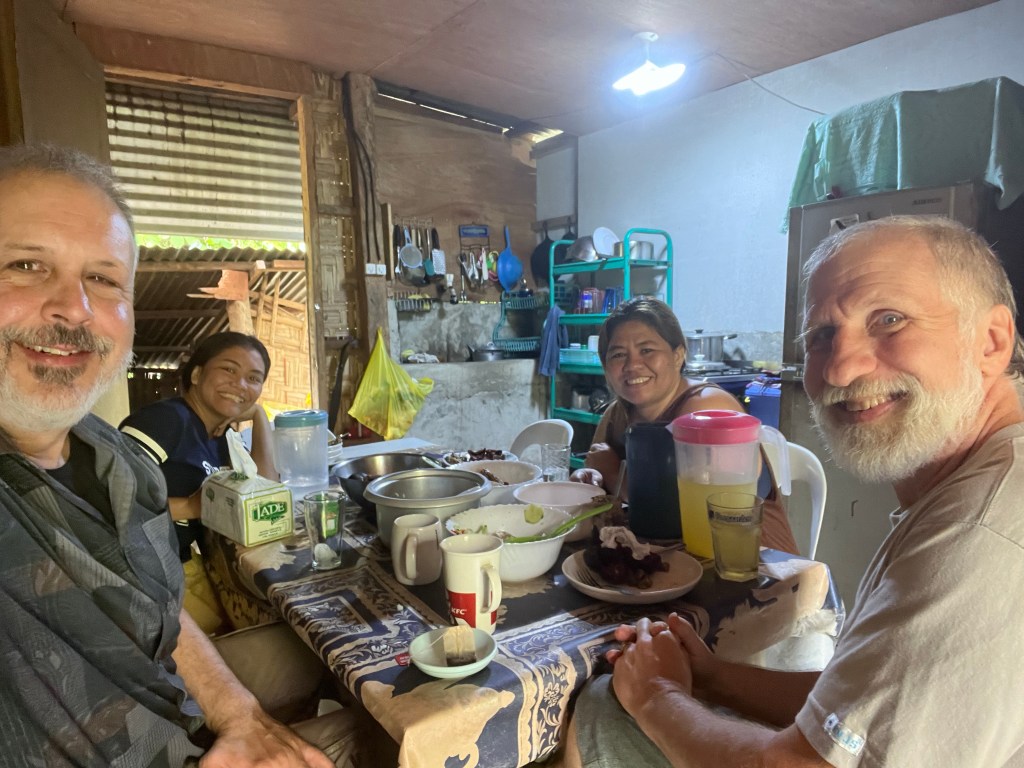
A massive feast has been prepared for us – and for the drivers who are due to arrive any moment. Chicken adobo is the national dish of the Philippines, with regional and familial variations of a nearly infinite number. It’s almost always delicious, savory and redolent with the spices Southeast Asia became known for in the West, but without the spiciness Indonesians relish so much. Along with this was a kind of ceviche – large chunks of tuna and onions and cucumber slices marinated in citrus juice, ‘cooking’ the meat without heat. It was incredible. I love Mexican ceviche and so the opportunity to taste a Filipino variation (with the Spanish as likely sources of both traditions) made me very happy. And of course rice.
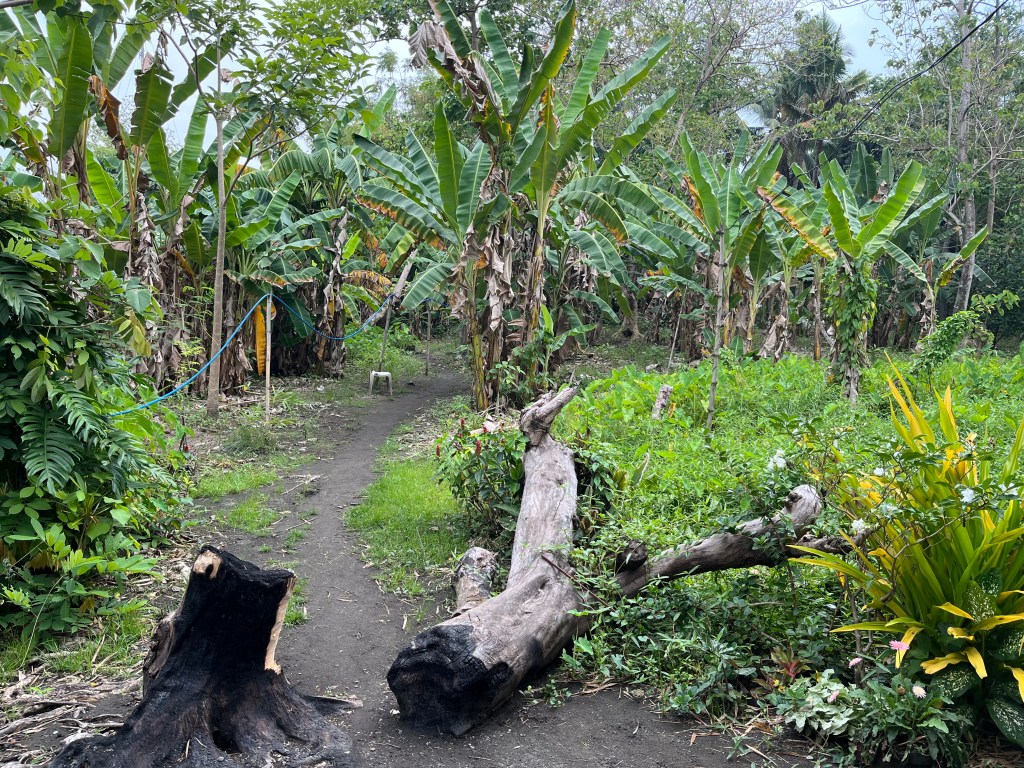
The drivers were not on time – hardly surprising in Southeast Asia. But they eventually arrived and were obligated to sit and eat as well. They didn’t seem too sad about this. Hospitality and food are crucial elements of Filipino society and you don’t refuse food when it’s offered to you. A short time later we were on the road, after walking back through the front yard below:
We had been driving for maybe 30 minutes when we pulled to the side of the road along a row of low shanties doubling as storefronts. It was time for durian.
Ah, durian.
There is perhaps no better unifying thread to Southeast Asian culture than durian, where it is universally revered as the greatest and most delicious of all the fruits. This being said, every public place in Southeast Asia has large signs posted everywhere inside and out forbidding anyone from bringing durian into the premises. Trains, planes, airports, hotels, convenience stores, restaurants – durian is not welcome anywhere, though it is beloved by all.
The exception are durian markets and durian dining facilities – places that specialize in durian and usually only durian. Here, locals make merry indulging without guilt or fear in their favorite fruit. Although the fruit is not cheap, for locals there’s no better way to spend an evening than tearing into one or more durian with a group of friends over loud conversation and laughter. It’s truly a sight to behold.
It’s also something to smell, which is the reason durian is banned most everywhere else. The scent is unpleasant and even the locals will acknowledge this. But additionally the scent has staying power. It clings to your fingers – so most places serve it with disposable plastic gloves. God-forbid you spill it on your clothes. It’s hard to describe. Frankly, I don’t think it smells that bad, which is probably a sad commentary on my personal hygiene rather than some bragging point. Imagine several pairs of adolescent sweaty gym socks left to marinate undisturbed in a humid locker room for a semester and then extracted and inhaled. That’s something akin to the smell of fresh durian. Many people liken it to rotting flesh, but I find this an even more disturbing potential comment on their personal hygiene than mine, and so I don’t use this comparison. It may be relevant. I’m happy to ignore that fact.
And then the taste. Hmmm. In Indonesia they swear tourists have to eat durian three times. The first time you’ll abhor it. The second time you’ll be ambivalent. The third time you will be hooked for life and loudly and vehemently exclaim and protect durian’s unparalleled status as the king of fruits with your dying breath. This roadside stand was my third official indulgence and I find I don’t mind it. Certainly not if it’s part of being a social and gracious guest in a foreign country.
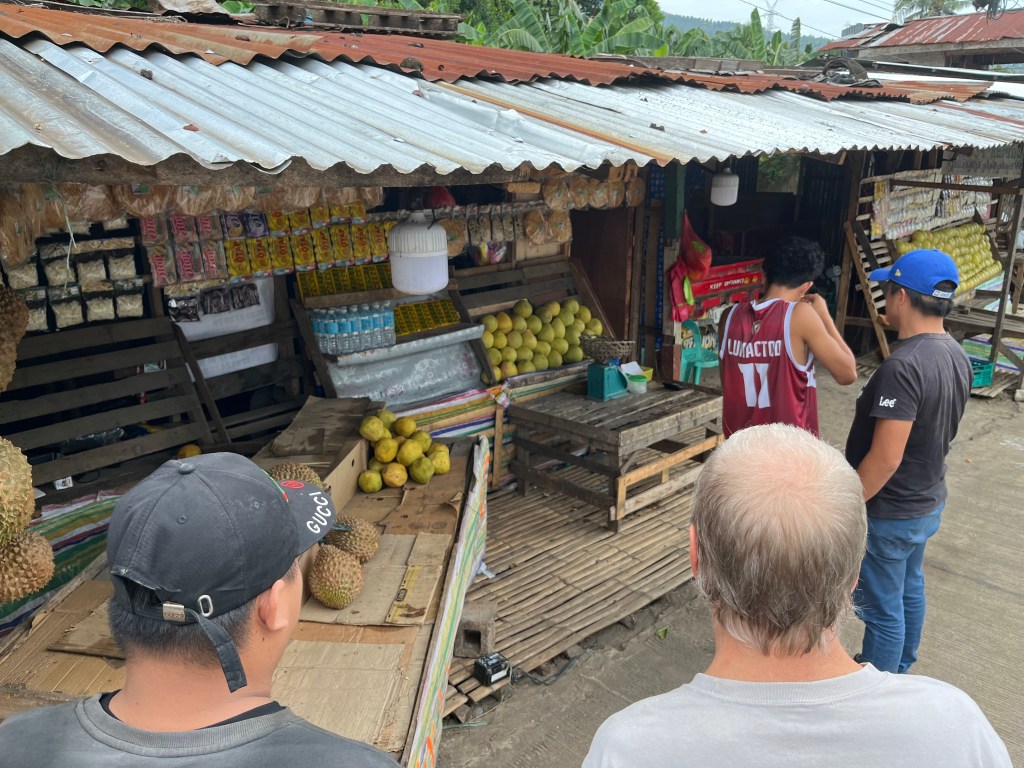
I asked how to tell a good durian from a bad one, because there are bad ones and I can only imagine they are very bad. They assured me that was the job of the vendor – to pick out the best durian available for them. And to be fair, it wasn’t a bad durian, as durians go.

The fruit is large and weighs between 3-7 pounds. It grows high up in the trees and if you happen to be unfortunately placed when one falls, it could kill you. Or make you wish it had killed you. In addition to the size the exterior is a network of squat, pointy bits that are unpleasant to handle even if it’s not landing on you or being hurled at you. The vendor will split the durian into quarters, and each quarter holds a large lobe of fruit. Not unlike a very pale kidney, I imagine. There are large seeds buried in there as well which you don’t eat. You break off a piece of the lobe and munch away at the flesh, eating around the seed.
The texture is hard to describe. Imagine a kind of stringy custard or flan. There’s a smoothness to it which is unusual in fruit. I think a very ripe cherimoya is the closest I’ve ever had to this consistency but there are some parallels with bananas I suppose. It’s creamy. It clings a bit to the roof of the mouth and the tongue and a swallow or two of water helps it move along the right direction. Locals say the fruit heats up the body and so – at least in Indonesia – it is never served with beer as this would be too much heat for the body. I’m not sure if they believe you’ll explode, but they certainly don’t think it’s good for you.
Locals love to watch foreigners eat durian, amazed at our unfamiliarity with it. Except Pastor Roeske and I aren’t exactly newbies at it. We each eat a respectable portion of the durian without being selfish – an important piece of durian eating etiquette. Then we peel off our plastic gloves and hit the road again.
We stop at a large market in a village where Pastor Roeske picks up drinking water and toilet paper. Oh. No. I didn’t bring toilet paper. I begin to have a strange sense of foreboding that I won’t devote any more digital ink to. Then a short time later we’re off the paved road and on a very unpaved road. Fortunately the weather has been dry so it’s not muddy. Just not smooth. We rattle along it for about 30 minutes before pulling into the town of San Roque. About 300 yards of small storefronts and a few houses behind.
That’s it.
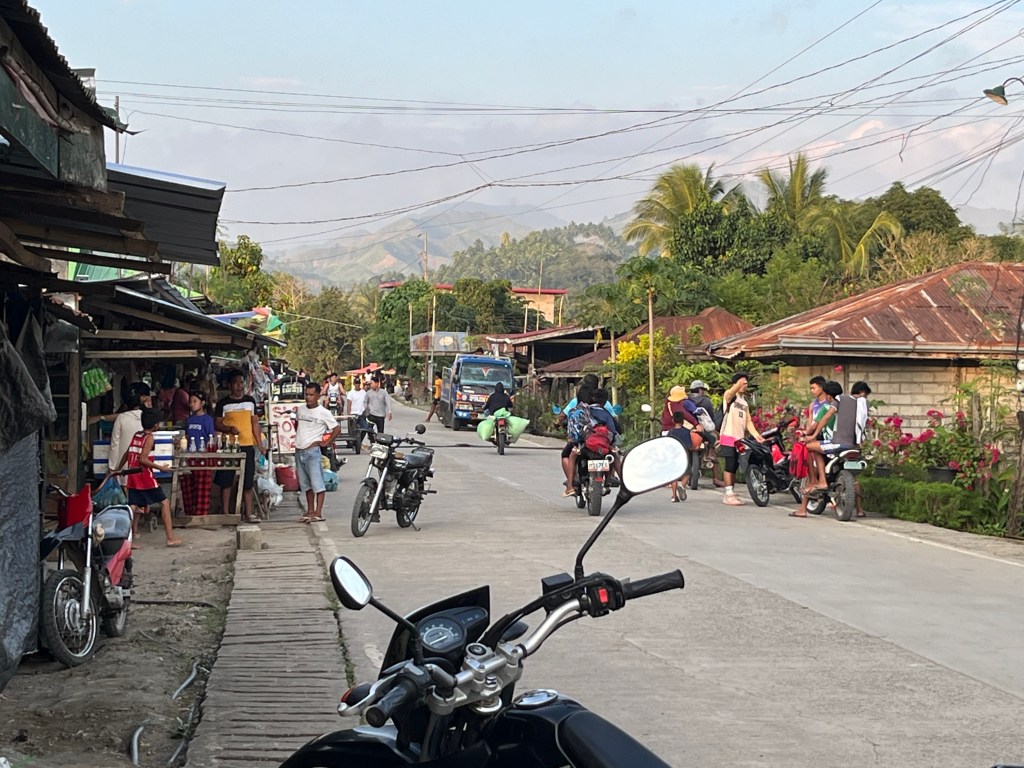
It’s Saturday mid-afternoon when we arrive. No, I am not riding that motorcycle, just standing behind it. We are at the home of Pastor Panes, president of the Tagakalau Lutheran Church of Christ in the Philippines (TLCCP). He is hosting Pastor Roeske and I and we each have a small room on the second level of the home. We are welcomed with rice and chicken adobo and then the afternoon is open. People are all out and about. I don’t know if weekends have the same connotation in a rural mountain village as they do in an urban Western city but there’s definitely a buzz in the air. We are far from anything, yet surrounded by God’s beauty.
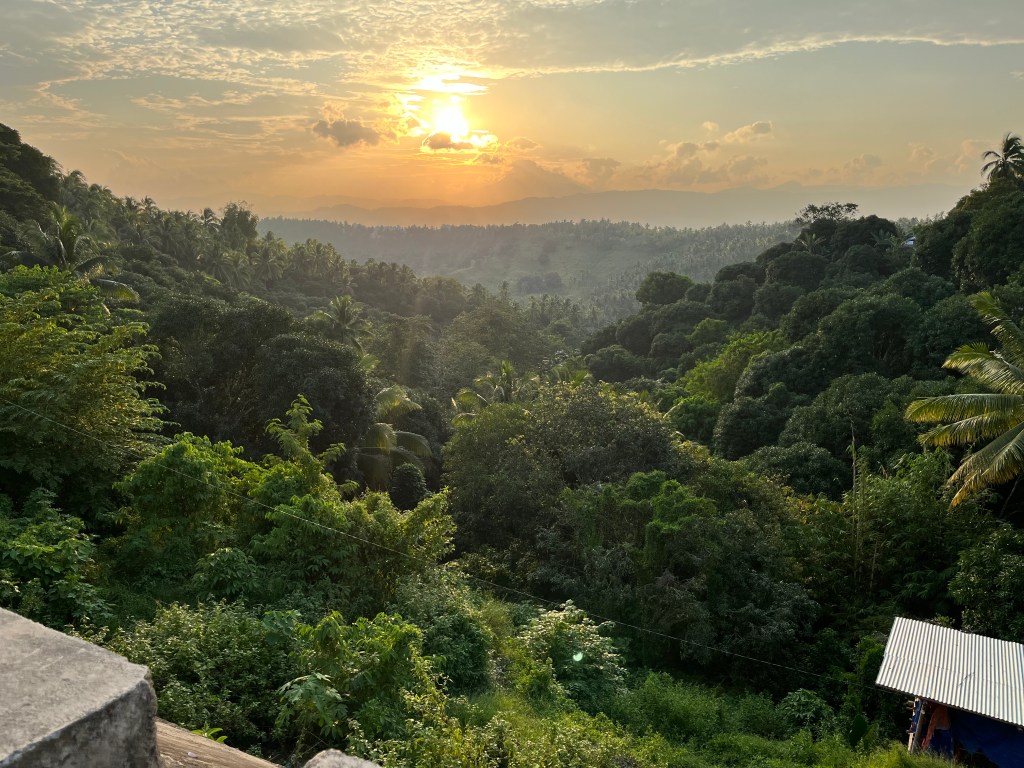
My first night in this new place is a little stressful. Typical pre-work jitters, no different in some respects than Sunday morning before worship preaching jitters. Or pre-Bible study jitters. But there’s a stronger edge to the jitters because of the absolute pitch blackness beyond the halo of limited street lighting. A stronger edge wondering what I’m doing here in the middle of nowhere, unable to speak either the local dialect or the national language. A few minutes or an hour or so of soul searching as to what has brought me to this moment in this place, and whether or not I may have missed a signpost or two along the way.
And then sleep falls, blessedly. God will provide. Or He won’t. Either way I rest in his hands. If I wake in the morning it’s because He wills it to be so and I will serve to the best of my ability. If I don’t wake here, I’ll wake elsewhere – hopefully in glory. And the waiting there won’t be so bad, I presume.
And I won’t have to worry about durian again until the resurrection.


 The Nelson Family Indonesia